
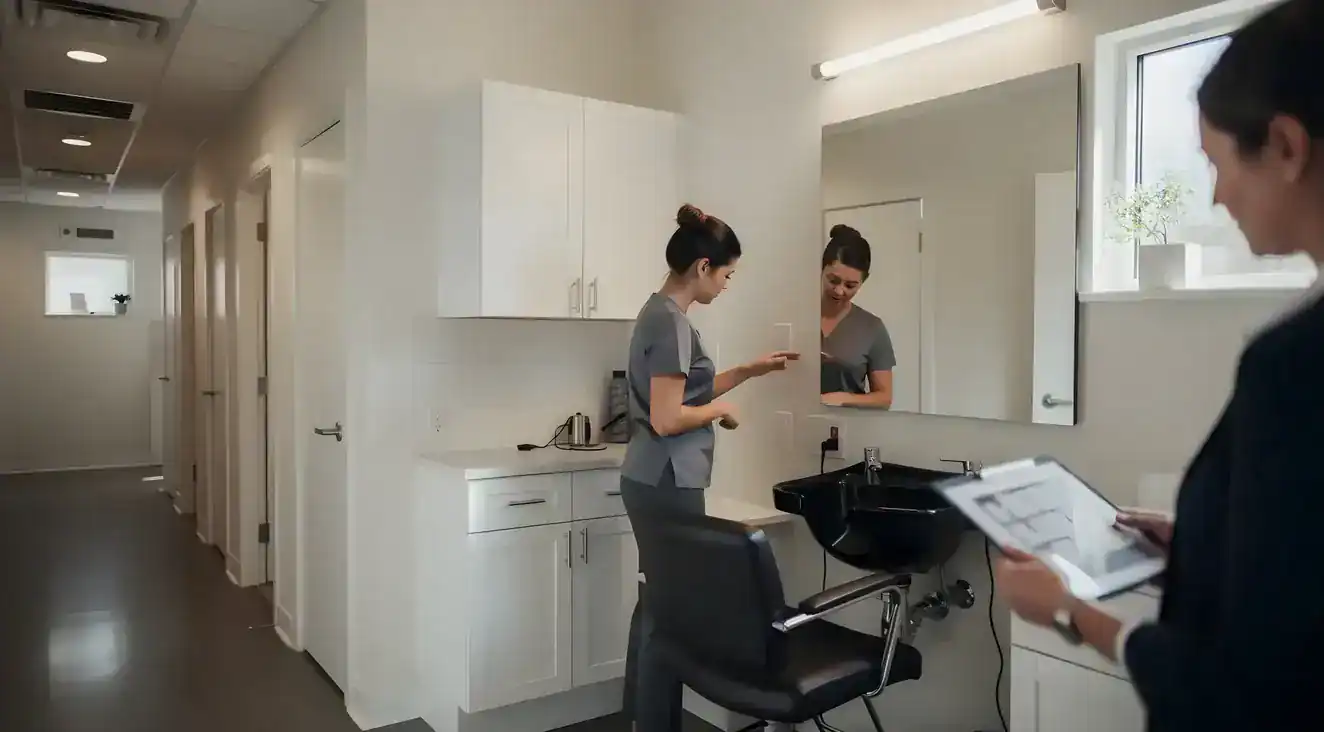
A salon suite lease commits a licensed beauty professional to a fixed monthly overhead, a specific building environment, and a client access window that directly shapes their income potential. The right suite has five things working in your favor: all-inclusive rent that covers utilities, internet, and common area costs so you can budget with confidence; a fully furnished private space with its own hot and cold water connection; 24/7 keyless access so your schedule is yours to set; a lease term that matches where your business is right now; and on-site management that is present and accountable when something needs fixing.
The most common mistake licensed beauty professionals make when evaluating salon suites is focusing on base rent without asking what is billed separately. Utilities, high-speed internet, and common area fees can add hundreds to a monthly cost that looked reasonable on paper. A salon suite with transparent, all-inclusive rent makes every one of those costs clear before you sign. Unlike a booth rental inside a commission-based salon, a private salon suite gives you full control over your pricing, your product choices, and every dollar you earn. Here is what to look for in each area, and what a strong answer sounds like at every stop.
The term “all-inclusive rent” gets used loosely in the salon suite industry, so ask for a specific definition at every facility you tour. A true all-inclusive rate for a salon suite rental bundles electricity, water, high-speed WiFi, and common area maintenance into a single flat figure. No separate bills arrive at the end of the month. No line items you did not budget for.
Watch out
⚠️ Red Flag: Utilities Billed Separately
If any part of your tour includes the phrase "utilities billed separately," "WiFi available at additional cost," or "common area maintenance fee applied monthly," stop and get a total monthly cost in writing before you go any further. A suite that looks affordable at the base rate can cost hundreds more per month once the add-ons stack up. Any facility that cannot give you a clear all-in total before you sign is telling you something important.
Key takeaway
⭐ Five Things Working in Your Favor
The strongest salon suites give you five things at once: all-inclusive rent with no surprise fees, a fully furnished private suite with its own hot and cold water connection, 24/7 keyless access so your schedule is yours to set, a lease term (6-month or 12-month) that fits where your business is right now, and on-site management that is present and reachable when something goes wrong. If a suite you are touring cannot check all five, keep looking.
A salon suite priced attractively on a base rent model can cost meaningfully more once utilities, internet, and cleaning fees stack on top, which is why comparing facilities requires a total monthly cost figure, not just a base rate. Before you compare any two facilities, ask for the total monthly cost in writing, including every charge the lease agreement allows the facility to pass through.
Watch for specific red-flag language: “utilities billed separately,” “WiFi available at additional cost,” “common area maintenance fee applied monthly,” or any recurring charge without a fixed cap. If a facility cannot give you a clean, itemized total before you sign, that is a sign the total is not something they want you to see clearly.
On the amenity side, strong facilities also provide shared access to commercial washers and dryers, a breakroom, and clean common areas for clients. These are part of the value, and they belong on your salon suite rental checklist alongside the rent structure.
What all-inclusive rent does not cover, regardless of the facility: your own product inventory, professional liability insurance, booking software, and specialty tools you bring in yourself. The clearer that line is in the lease and during your tour, the better you can plan for your actual costs as an independent beauty professional.
A fully furnished salon suite means something specific, and “fully furnished” is worth pressing on during your tour. For a hair suite at minimum, it should include a styling chair, a shampoo bowl with a direct hot and cold water connection, a salon mirror, a work surface, and storage. For nail suites: a nail table, client chair, and technician stool. For esthetics and lash suites: a treatment bed and cabinetry. Ask for the specific inventory list, not just a verbal confirmation that the suite is “ready to go.”
The in-suite plumbing question deserves its own moment on your tour. A shampoo bowl with its own hot and cold water connection directly in the suite is not the same as shared shampoo areas down the hallway. For a hair stylist, the difference shows up in every color service: you complete the service, walk the client directly to the bowl in your private room, rinse, and return. No navigation between appointments. No waiting for a shared station to open. Your client’s experience stays contained in your space from start to finish.
A move-in ready suite means an independent beauty professional can serve their first client on Day 1 without additional equipment purchases. If a suite is described as move-in ready but requires you to supply your own shampoo bowl or figure out a water access workaround, it is not move-in ready.
Customization rights are worth getting in writing before you sign. Can a licensed cosmetologist paint the walls, add shelving, hang signage, and style the space to match their brand? The best salon suites answer yes. Your clients should walk through the door and feel like they are stepping into your business, not a generic rental room. Some facilities prohibit permanent changes, which limits your ability to build a branded environment over time. Get the policy in writing, not as a verbal assurance.
Location matters most from your client’s perspective, not your commute. Can clients find the building easily? Is parking free, plentiful, and obvious from the street? Restricted or confusing parking loses appointments before they start. A client circling a parking lot before a highlights appointment arrives stressed, not relaxed.
By the numbers
ℹ️ The 10-15 Minute Rule
Beauty professionals who relocate more than 10 to 15 minutes away from their existing clientele consistently report losing a measurable portion of their active book within the first 90 days. For an established hair stylist or nail technician, that drop directly affects income while you are simultaneously adjusting to a new cost structure. Location is not just convenience: it is a retention variable with a real dollar value attached to it.
Stylists who relocate more than 10 to 15 minutes from their existing clientele consistently report losing a portion of their active book during the first 90 days, which is why proximity to your current client base is one of the highest-stakes variables in the evaluation. For a hair stylist or nail technician with an established book, your location decision directly affects how many of those appointments you keep.
Neighborhood context matters too. The surrounding area should align with the client base you serve. A salon suite facility on a well-trafficked road with easy access from major DFW corridors reduces friction for clients traveling from across the metro. At Addison Salon Suites and Spa on Belt Line Road in Addison, TX, the location sits in a North Dallas corridor that draws clients from Dallas, Plano, and Richardson with straightforward access and plenty of on-site parking.
Restricted building hours cap your income in a direct, calculable way. A salon suite facility that closes at 7pm means you cannot take a 6:30pm color client without rushing, or without a client feeling like they need to wrap up and leave. No early-morning appointments on your own terms. No Sunday availability for clients who work Monday through Friday.
Next step
💡 Test the Entry System on Your Tour
Do not just ask whether keyless entry exists. Ask to use it yourself during your tour. Walk up to the door, enter credentials, and see what the experience actually feels like. Then ask whether shared spaces (laundry, breakroom) operate on the same unrestricted access or run on separate hours. True 24/7 access means every part of the facility you pay for is available every hour of the day, not just your individual suite door.
A salon suite with 24/7 keyless access resolves this completely. When the building is accessible around the clock via app, PIN, fob, or key card, your schedule is determined by your clients and your own choices, not a posted sign on the door. A licensed cosmetologist who can serve early-morning clients before 9am or late-evening clients after 7pm captures income that a restricted-access facility simply blocks.
The security system operates through the keyless entry system itself: every entry is logged with a timestamp in an access record, access credentials can be revoked instantly without rekeying physical locks, and clients arrive to a professional entry experience with no confusion about which entrance to use or who to buzz.
Ask specifically on your tour: Is building access 24/7 with no exceptions? Are any common areas, such as laundry or the breakroom, restricted to certain hours even if suite access is unrestricted? A salon suite facility that offers true 24/7 access should be able to answer those questions directly.
The two standard lease structures in the salon suite industry are 6-month and 12-month lease agreements. Both are legitimate options. The right one depends on where your business is right now.
A 6-month salon suite lease is a lower-risk entry point for a beauty professional who is newly independent, relocating an existing book to a new area, or testing whether a specific DFW location will grow their clientele. It creates a natural check-in point at six months without a long-term penalty if the fit is not right.
A 12-month lease agreement suits a licensed cosmetologist, esthetician, or nail technician with an established book and a stable client base who wants predictability in their cost structure. It eliminates the renewal conversation every six months and provides a steady foundation for a growing independent business.
Whichever term you choose, read the specific lease clauses before you sign. What is the notice period for renewal? What happens at the end of the term if you do not renew? What are the early termination conditions, and what do penalties look like? Any clause requiring more than 60 days notice for termination without cause, or penalties that equal more than two to three months of rent, deserves a hard look.
In Texas, every beauty professional operating inside a salon suite must hold a current license issued by the Texas Department of Licensing and Regulation (TDLR). TDLR issues separate license categories for cosmetologists, estheticians, nail technicians, and barbers, and each category is required before operating the corresponding service inside a Texas salon suite. This applies to hair stylists, lash artists, and anyone providing a regulated beauty service. Most facilities will ask for a copy of your TDLR license along with a valid ID, proof of professional liability insurance, and a security deposit before signing. Have those ready.
Suite sharing is a legitimate option worth asking about directly. Some salon suite facilities allow two beauty professionals to schedule non-overlapping hours in the same suite, splitting the cost and the space. For a professional who is not yet at full client capacity, suite sharing is a lower-risk way to enter an independent model without carrying the full cost of a solo suite lease. Not every facility offers it. Ask specifically, and get the answer in writing.
On-site management has more direct impact on your daily work life than any single amenity in the suite itself. There is a practical difference between an on-site owner and a corporate management chain. When the shampoo bowl backs up at 5pm on a Friday, who answers? An on-site owner who is in the building regularly knows their tenants by name, knows which suites have quirks, and has a direct stake in getting issues resolved quickly. A ticket system routed through a regional office may take days.
On-site management signals accountability in a deeper way too. An owner who treats the salon suite facility as a community rather than a passive income stream stays invested in each tenant’s success. The building stays well-maintained because the owner is present to see it. High occupancy and long average tenancy are both outcomes of that kind of management. Ask on your tour: Who do I contact if something breaks, and what is the typical resolution time?
A salon suite facility is not just a building. It is an ecosystem of licensed beauty professionals who serve overlapping client demographics every week. In a well-occupied facility with 15 to 25 different professionals, cross-referrals happen organically. The hair stylist refers her nail client to the nail technician two doors down. The lash artist sends facial clients to the esthetician. The massage therapist recommends brow work to a client who asks about it.
Tenant-to-tenant referrals represent real income that compounds over time as relationships develop between independent professionals in the same building. Ask the facility how many suites are occupied and how long the current tenants have been there. Both numbers reflect the health of the community.
One question most beauty professionals never think to ask: does the facility link tenant websites to the main salon site? A licensed cosmetologist or independent stylist listed and linked from an established salon domain gains a genuine local SEO benefit for their own search visibility. Being linked from an authoritative domain in the Addison TX and North Dallas market gives a newly independent professional a meaningful head start over building from zero. Most salon suite facilities do not offer this. Ask specifically.
A booth rental is a station inside an open-floor salon. The beauty professional shares the room, the branding, and often the scheduling policies of the employing salon. A salon suite is a private, lockable room where you operate your own business under your own name, set your own prices, choose your own products, and keep 100 percent of what you earn. A private lockable room gives a licensed cosmetologist full control over consultation privacy, appointment pacing, and the client environment that a shared booth inside an open salon floor cannot provide. The autonomy changes everything about how you operate as an independent professional.
Most salon suite facilities offer 6-month and 12-month lease agreements as standard options. A 6-month lease gives a newly independent beauty professional a lower-risk entry point before committing to a longer term. A 12-month lease tends to suit licensed cosmetologists and established professionals with a full client book who want predictable costs. Ask about renewal terms and the required notice period before your first agreement ends.
The most important questions are: What is the total all-inclusive monthly cost with no separate fees? Who manages the facility and are they on-site regularly? Is the shampoo station plumbed directly inside the suite rather than shared down a hallway? Is building access 24/7 with keyless entry? Can I share the suite with another beauty professional if needed? Does the facility link tenant websites to the main salon site for local SEO benefit? The answers tell you more about the actual experience than the decor ever will.
Customization policies vary by facility. In a quality salon suite, you should be able to decorate, add shelving, and style the space to reflect your brand and give clients a consistent, branded experience. Ask specifically what is permitted before you sign. Paint, signage, shelving, and permanent fixtures are the main areas to clarify. Get the customization policy in writing as part of your lease agreement.
The tour is where the checklist becomes real. Facilities that meet these standards welcome every question on this list because they have clear answers ready. If a tour feels evasive on cost transparency, management availability, or lease specifics, that is worth knowing before you sign.
Walk through the physical space with the plumbing, furnishings, and customization questions ready. Ask about on-site management and the tenant community with the referral ecosystem in mind, not just the amenities brochure. And check the keyless entry system yourself: ask to see how it works, not just hear that it exists.
To see how these criteria map to the available suites at Addison, a tour is the fastest way to get real answers on every item. When you are ready to walk through the checklist in person, you can schedule a tour and see the suite, the building, and the community before you commit to anything.
the owner has been the on-site owner of Addison Salon Suites and Spa at 4930 Belt Line Rd, Addison, TX, since January 2015. He works alongside tenants daily and is available directly when issues arise.